My Coin Collection and Numismatics
Coins, Bank Notes, Antiques, and Books Collection. They are Pieces of History.
Tuesday, August 11, 2009
Monday, September 08, 2008
Gold mas or tahil ingot
Friday, September 05, 2008
Tuesday, August 05, 2008
Thursday, May 08, 2008
Ming's Old Coins Founded in Nganjuk

At least 1.749 old coins founded by Manirin (50), a red onion farmer in Balonggebang Village, Gondang, Nganjuk Regency, East Java. These coins estimated as Chinese remains. The size of them is bigger than the 500 rupiahs coin. In the center of it, there is a square hole and 4 chinese characters. Each coin has different characters.
Monday, March 03, 2008
Bank of Indonesia will Produce New Coin
Bank of Indonesia (BI) will produce the bank notes of Rp 2.000,00 in second semester of 2008. While the bank notes of Rp 1.000,00 will print in the coin shape start on the year 2009. Budi Rochadi said that the production of the new bank notes and the change of the money shape is to considerating people need and to efficiently the cost of money making.
Wednesday, February 27, 2008
Coin collecting Starter Kits

The collecting of coin and the study of the coins (or the numismatics) are a pastime which undoubtedly enriches those which practise it. The gathering of coin is suppose mainly about the history, but it also teaches elements of science, archaeology, geography, of policy, languages, maths, of art (and appreciation of art) and moreover. The new collectors of coin are the future of its fabulous pastime.
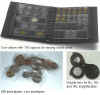
You can find interesting coin collecting starter kits such as coin album, envelopes, lens, etc. in here.
Monday, February 11, 2008
Why 17th Century Javanese Coins Found in Thames Mud?

This story told by Mr. Puji Harsono that the messenger from the Bantam Kingdom (Old Banten) ever came visited England in 1682. That's why the 17th century Javanese coins found in Thames mud.
Thursday, January 31, 2008
Friday, January 25, 2008
My Small Coin Album Page #1

My Small Coin Album Page #1: Republica de Chile 100 Pesos, Greeks, Republique Francaise 10 Francs 1976, Nepal, Republica de Chile 50 Pesos, RF 10 Francs Liberte - Egalite - Fraternite 1989.
Labels: coins, collection, francs, pesos
Koningrijk der Nederlanden 1 Cent 1920 Coin


This is the picture of The Kingdom of Nederlands (Koningrijk der Nederlanden) 1 Cent 1920 Coin. The coin diameter size is very small.
Labels: coins, collection, nederland
Wednesday, January 23, 2008
The Story of Dutch East Indies Tenth Gulden

I don't know that the Dutch East Indies Tenth Gulden coin has an unique story untill I read this: "These coins were minted in the USA for the Netherlands during WW2, when the royal mint at Utrecht was not available. They were intended for use in the unnocupied portions of the Indies.."
It has just 15 mm in diameter and made of .7200 silver. Very small coin. These coins are uncirculated and issued in year 1941.
Monday, January 21, 2008
Free Coin Software

I found a free Euro and Dollar coin software on Free Downloads Center website. This software is just for those two currencies. The software name is Find Coins Viewer.
Find Coins Viewer is the software utility of online website of www.findcoins.eu. On this site, I can find information about coins of world and where I can manage online my collection to easily swap with other user.
To use the software, you can follow these steps:
- Enter the preferred filters on the left search panel
- Press the Search button. The coins list will shown.
- Select a coin on the list by click it to show the correlated informations on the right window.
Please note, you need an internet connection to use this software.
Thursday, January 17, 2008
Understanding the History of a Nation through Coin
The money is not just an exchange tool, but as a symbol of civilization too (politics, culture, and era). Therefore, money has multifunction. If we read the development of a currency, we can tell a story about the condition of a nation and all of the civilization journey history.
The journey of Indonesia history could be seen on the currency too. The Kindom of Djenggala (856-1158 M) is the first kindom which use currency (9th - 12th century). In 7th century, it's known that at the first time the currency made from silver in semi circular (half-circle) form. There is the carved of vase and billowing smoke on its face. On the back, the carved of Padma flower at the center of a frame.
Except to half-circle form, there are coins in the rectangular and button form which carved with ancient Javanese character.
In the Djenggala era at Kediri which known as the oldest kingdom on Java Island, the money was called by name "Krishnala". The money was made of silver and bronze. In the Majapahit era, the money was known by name "Gobog", looks like the Chinese gobog. Form in thin-circle and there was a rectangle hole at its center. In general, the Gobog money has carved of animal, puppet, and the relief which symbolize a people tale on that time.
There is more in the Kingdom of Banten, the currency which has the form as like as the Majapahit's Gobog money. In the Kingdom of Sumenep, the money called by name "Real Batu". That money supposed come from the Kingdom of Spanish's currency, but modificated by put a stamp of Arabian character "Soemenep", "Number" or "Rose flower".
At the Kingdom of Gowa, South Sulawesi, the Dinar money which made of gold was known in the Sultan Hasanuddin era (17th century). It's look like the Derham Aceh. In Banjarmasin, known as "Doewit" and circulating around year 1812, made of tin.
The currency which mold by the Kingdom of Buton, has difference to the other kingdom currencies, because it doesn't use metal, but fabric material which weaved by the king daughter. It's popular by name "Kampua" or Bida".
The journey of Indonesia history could be seen on the currency too. The Kindom of Djenggala (856-1158 M) is the first kindom which use currency (9th - 12th century). In 7th century, it's known that at the first time the currency made from silver in semi circular (half-circle) form. There is the carved of vase and billowing smoke on its face. On the back, the carved of Padma flower at the center of a frame.
Except to half-circle form, there are coins in the rectangular and button form which carved with ancient Javanese character.
In the Djenggala era at Kediri which known as the oldest kingdom on Java Island, the money was called by name "Krishnala". The money was made of silver and bronze. In the Majapahit era, the money was known by name "Gobog", looks like the Chinese gobog. Form in thin-circle and there was a rectangle hole at its center. In general, the Gobog money has carved of animal, puppet, and the relief which symbolize a people tale on that time.
There is more in the Kingdom of Banten, the currency which has the form as like as the Majapahit's Gobog money. In the Kingdom of Sumenep, the money called by name "Real Batu". That money supposed come from the Kingdom of Spanish's currency, but modificated by put a stamp of Arabian character "Soemenep", "Number" or "Rose flower".At the Kingdom of Gowa, South Sulawesi, the Dinar money which made of gold was known in the Sultan Hasanuddin era (17th century). It's look like the Derham Aceh. In Banjarmasin, known as "Doewit" and circulating around year 1812, made of tin.
The currency which mold by the Kingdom of Buton, has difference to the other kingdom currencies, because it doesn't use metal, but fabric material which weaved by the king daughter. It's popular by name "Kampua" or Bida".